Tuesday

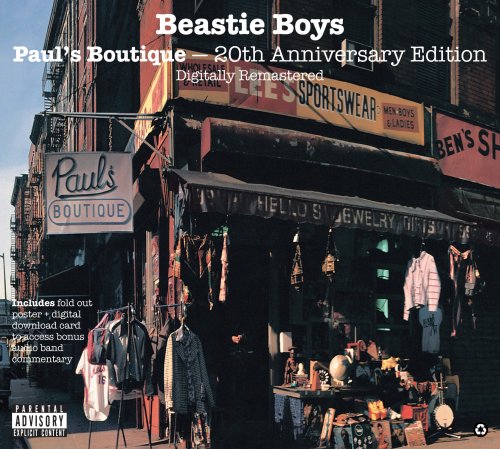
Beastie Boys:"Paul's Boutique" (1989)

Such was the power of Licensed to Ill that everybody, from fans to critics, thought that not only could the Beastie Boys not top the record, but that they were destined to be a one-shot wonder. These feelings were only amplified by their messy, litigious departure from Def Jam and their flight from their beloved New York to Los Angeles, since it appeared that the Beasties had completely lost the plot. Many critics in fact thought that Paul's Boutique was a muddled mess upon its summer release in 1989, but that's the nature of the record -- it's so dense, it's bewildering at first, revealing its considerable charms with each play. To put it mildly, it's a considerable change from the hard rock of Licensed to Ill, shifting to layers of samples and beats so intertwined they move beyond psychedelic; it's a painting with sound. Paul's Boutique is a record that only could have been made in a specific time and place. Like the Rolling Stones in 1972, the Beastie Boys were in exile and pining for their home, so they made a love letter to downtown New York -- which they could not have done without the Dust Brothers, a Los Angeles-based production duo who helped redefine what sampling could be with this record. Sadly, after Paul's Boutique sampling on the level of what's heard here would disappear; due to a series of lawsuits, most notably Gilbert O'Sullivan's suit against Biz Markie, the entire enterprise too cost-prohibitive and risky to perform on such a grand scale. Which is really a shame, because if ever a record could be used as incontrovertible proof that sampling is its own art form, it's Paul's Boutique. Snatches of familiar music are scattered throughout the record -- anything from Curtis Mayfield's "Superfly" and Sly Stone's "Loose Booty" to Loggins & Messina's "Your Mama Don't Dance" and the Ramones' "Suzy Is a Headbanger" -- but never once are they presented in lazy, predictable ways. the Dust Brothers and Beasties weave a crazy-quilt of samples, beats, loops, and tricks, which creates a hyper-surreal alternate reality -- a romanticized, funhouse reflection of New York where all pop music and culture exist on the same strata, feeding off each other, mocking each other, evolving into a wholly unique record, unlike anything that came before or after. It very well could be that its density is what alienated listeners and critics at the time; there is so much information in the music and words that it can seem impenetrable at first, but upon repeated spins it opens up slowly, assuredly, revealing more every listen. Musically, few hip-hop records have ever been so rich; it's not just the recontextulations of familiar music via samples, it's the flow of each song and the album as a whole, culminating in the widescreen suite that closes the record. Lyrically, the Beasties have never been better -- not just because their jokes are razor-sharp, but because they construct full-bodied narratives and evocative portraits of characters and places. Few pop records offer this much to savor, and if Paul's Boutique only made a modest impact upon its initial release, over time its influence could be heard through pop and rap, yet no matter how its influence was felt, it stands alone as a record of stunning vision, maturity, and accomplishment. Plus, it's a hell of a lot of fun, no matter how many times you've heard it.
Woody Allen:"Everything You Always Wanted to Know About Sex, But Were Afraid to Ask" (1972)

Woody Allen's in-name-only adaptation of the once notorious sexual reference guide by Dr. David Reuben contains seven episodes based on "helpful" questions answered in the book. In "Do Aphrodisiacs Work?", Allen appears as a court jester who uses a love potion to spark the erotic interests of the Queen (Lynn Redgrave). "What Is Sodomy?" stars Gene Wilder as a doctor who throws away his marriage, career, and position in the community when he falls madly in love with an Armenian sheep named Daisy. "Why Do Some Women Have Trouble Reaching Orgasm?" is a parody of stylish Italian films of the '60s in which a slick playboy (Woody Allen) discovers his wife (Louise Lasser) can climax only when they make love in public places. In "Are Transvestites Homosexuals?," Sam (Lou Jacobi) has his little secret revealed at a most inopportune moment. "What Are Sex Researchers Actually Accomplishing?" features John Carradine in a great parody of his mad-scientist roles as Dr. Bernardo, whose research into human sexuality has led to a fearsome mutation -- a 50-foot tall female breast! "What Are Sexual Perversions?" takes us to a broadcast of the popular game show What's My Perversion?, in which Jack Barry leads a panel of celebrities (including Regis Philbin and Robert Q. Lewis) in guessing the erotic obsessions of their guests. And "What Happens During Ejaculation?" takes the audience inside the body of a man in the throes of passion; The Brain (Tony Randall) guides the body's functions, with the help of his assistant (Burt Reynolds), while Allen plays a nervous sperm cell not sure if he can make the big jump. While the quality of the episodes is uneven, the best rank with the funniest moments of Allen's career, especially Gene Wilder's touching romance with the sheep ("I think we can make this work, Daisy") and the final sequence inside the male body ("What if he's only masturbating? I'll end up on the ceiling somewhere!").

Wednesday

The Zombies:"Odessey and Oracle" (1968)

Odessey and Oracle
Odessey and Oracle was one of the flukiest (and best) albums of the 1960s, and one of the most enduring long-players to come out of the entire British psychedelic boom, mixing trippy melodies, ornate choruses, and lush Mellotron sounds with a solid hard rock base. But it was overlooked completely in England and barely got out in America (with a big push by Al Kooper, who was then a Columbia Records producer); and it was neglected in the U.S. until the single "Time of the Season," culled from the album, topped the charts nearly two years after it was recorded, by which time the group was long disbanded. Ironically, at the time of its recording in the summer of 1967, permanency was not much on the minds of the bandmembers. Odessey and Oracle was intended as a final statement, a bold last hurrah, having worked hard for three years only to see the quality of their gigs decline as the hits stopped coming. The results are consistently pleasing, surprising, and challenging: "Hung Up on a Dream" and "Changes" are some of the most powerful psychedelic pop/rock ever heard out of England, with a solid rhythm section, a hot Mellotron sound, and chiming, hard guitar, as well as highly melodic piano. "Changes" also benefits from radiant singing. "This Will Be Our Year" makes use of trumpets (one of the very few instances of real overdubbing) in a manner reminiscent of "Penny Lane"; and then there's "Time of the Season," the most well-known song in their output and a white soul classic. Not all of the album is that inspired, but it's all consistently interesting and very good listening, and superior to most other psychedelic albums this side of the Beatles' best and Pink Floyd's early work. Indeed, the only complaint one might have about the original LP is its relatively short running time, barely over 30 minutes, but even that's refreshing in an era where most musicians took their time making their point, and most of the CD reissues have bonus tracks to fill out the space available

Martin Scorsese:"Raging Bull" (1980)

Raging Bull
Martin Scorsese's brutal character study incisively portrays the true rise and fall and redemption of middleweight boxer Jake La Motta, a violent man in and out of the ring who thrives on his ability (and desire) to take a beating. Opening with the spectacle of the over-the-hill La Motta (Robert De Niro) practicing his 1960s night-club act, the film flashes back to 1940s New York, when Jake's career is on the rise. Despite pressure from the local mobsters, Jake trusts his brother Joey (Joe Pesci) to help him make it to a title bout against Sugar Ray Robinson the honest way; the Mob, however, will not cave in. Jake gets the title bout, and blonde teenage second wife Vickie (Cathy Moriarty), but success does nothing to exorcise his demons, even as he channels his rage into boxing. Alienating Vickie and Joey, and disastrously gaining weight, Jake has destroyed his personal and professional lives by the 1950s. After he hits bottom, however, Jake emerges with a gleam of self-awareness, as he sits rehearsing Marlon Brando's On the Waterfront speech in his dressing room mirror: "I coulda been a contender, I coulda been somebody." Working with a script adapted by Mardik Martin and Paul Schrader from La Motta's memoirs, Scorsese and De Niro sought to make an uncompromising portrait of an unlikable man and his ruthless profession. Eschewing uplifting Rocky-like boxing movie conventions, their Jake is relentlessly cruel and self-destructive; the only peace he can make is with himself. Michael Chapman's stark black-and-white photography creates a documentary/tabloid realism; the production famously shut down so that De Niro could gain 50-plus pounds. Raging Bull opened in late 1980 to raves for its artistry and revulsion for its protagonist; despite eight Oscar nominations, it underperformed at the box office, as audiences increasingly turned away from "difficult" films in the late '70s and early '80s. The Academy concurred, passing over Scorsese's work for Best Director and Picture in favor of Robert Redford and Ordinary People, although De Niro won a much-deserved Oscar, as did the film's editor, Thelma Schoonmaker. Oscar or no Oscar, Raging Bull has often been cited as the best American film of the 1980s.

Friday

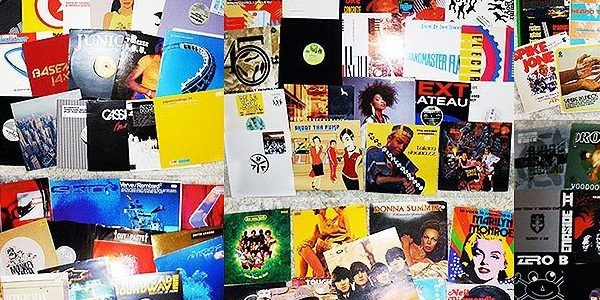
WILD IS THE WIND-One song 10 covers

1.David Bowie

2.Johnny Mathis

3.Nina Simone

4.George Michael

5.Billy MacKenzie

6.Randy Crawford

7.Nancy Wilson

8.Cat Power

9.Gloria Lynne

10.Barbra Streisand

Tom Waits:"Small Change" (1976)

Tom Waits Small Change
The fourth release in Tom Waits' series of skid row travelogues, Small Change proves to be the archetypal album of his '70s work. A jazz trio comprising tenor sax player Lew Tabackin, bassist Jim Hughart, and drummer Shelly Manne, plus an occasional string section, back Waits and his piano on songs steeped in whiskey and atmosphere in which he alternately sings in his broken-beaned drunk's voice (now deeper and overtly influenced by Louis Armstrong) and recites jazzy poetry. It's as if Waits were determined to combine the Humphrey Bogart and Dooley Wilson characters from Casablanca with a dash of On the Road's Dean Moriarty to illuminate a dark world of bars and all-night diners. Of course, he'd been in that world before, but in songs like "The Piano Has Been Drinking" and "Bad Liver and a Broken Heart," Waits gives it its clearest expression. Small Change isn't his best album. Like most of the albums Waits made in the '70s, it's uneven, probably because he was putting out one a year and didn't have time to come up with enough first-rate material. But it is the most obvious and characteristic of his albums for Asylum Records. If you like it, you also will like the ones before and after; otherwise, you're not Tom Waits' kind of listener.

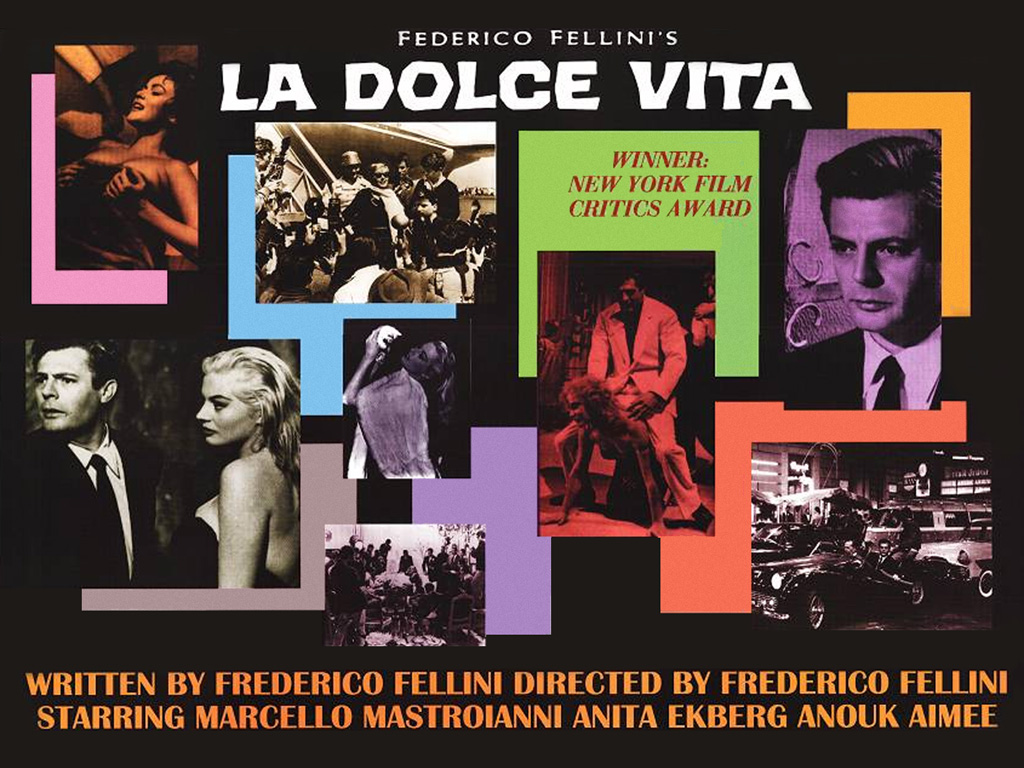
Federico Fellini:"La Dolce Vita" (1960)

La Dolce Vita (1960)
In one of the most widely seen and acclaimed European movies of the 1960s, Federico Fellini featured Marcello Mastrioanni as gossip columnist Marcello Rubini. Having left his dreary provincial existence behind, Marcello wanders through an ultra-modern, ultra-sophisticated, ultra-decadent Rome. He yearns to write seriously, but his inconsequential newspaper pieces bring in more money, and he's too lazy to argue with this setup. He attaches himself to a bored socialite (Anouk Aimée), whose search for thrills brings them in contact with a bisexual prostitute. The next day, Marcello juggles a personal tragedy (the attempted suicide of his mistress (Yvonne Furneaux)) with the demands of his profession (an interview with none-too-deep film star Anita Ekberg). Throughout his adventures, Marcello's dreams, fantasies, and nightmares are mirrored by the hedonism around him. With a shrug, he concludes that, while his lifestyle is shallow and ultimately pointless, there's nothing he can do to change it and so he might as well enjoy it. Fellini's hallucinatory, circus-like depictions of modern life first earned the adjective "Felliniesque" in this celebrated movie, which also traded on the idea of Rome as a hotbed of sex and decadence. A huge worldwide success, La Dolce Vita won several awards, including a New York Film Critics CIrcle award for Best Foreign Film and the Palme d'Or at the Cannes Film Festival.

Monday

John Huston:"The Maltese Falcon" (1941)

 The Maltese Falcon
After two previous film versions of Dashiell Hammett's detective classic The Maltese Falcon, Warner Bros. finally got it right in 1941--or, rather, John Huston, a long-established screenwriter making his directorial debut, got it right, simply by adhering as closely as possible to the original. Taking over from a recalcitrant George Raft, Humphrey Bogart achieved true stardom as Sam Spade, a hard-boiled San Francisco private eye who can be as unscrupulous as the next guy but also adheres to his own personal code of honor. Into the offices of the Spade & Archer detective agency sweeps a Miss Wonderly (Mary Astor), who offers a large retainer to Sam and his partner Miles Archer (Jerome Cowan) if they'll protect her from someone named Floyd Thursby. The detectives believe neither Miss Wonderly nor her story, but they believe her money. Since Archer saw her first, he takes the case -- and later that evening he is shot to death, as is the mysterious Thursby. Miss Wonderly's real name turns out to be Brigid O'Shaughnessey, and, as the story continues, Sam is also introduced to the effeminate Joel Cairo (Peter Lorre) and the fat, erudite Kasper Gutman (Sydney Greenstreet, in his film debut). It turns out that Brigid, Cairo and Gutman are all international scoundrels, all involved in the search for a foot-high, jewel-encrusted statuette in the shape of a falcon. Though both Cairo and Gutman offer Spade small fortunes to find the "black bird," they are obviously willing to commit mayhem and murder towards that goal: Gutman, for example, drugs Spade and allows his "gunsel" Wilmer (Elisha Cook Jr.) to kick and beat the unconscious detective. This classic film noir detective yarn gets better with each viewing, which is more than can be said for the first two Maltese Falcons and the ill-advised 1975 "sequel" The Black Bird.

Thin Lizzy :"Jailbreak" (1976)

Thin Lizzy Jailbreak
Thin Lizzy found their trademark twin-guitar sound on 1975's Fighting, but it was on its 1976 successor, Jailbreak, where the band truly took flight. Unlike the leap between Night Life and Fighting, there is not a great distance between Jailbreak and its predecessor. If anything, the album was more of a culmination of everything that came before, as Phil Lynott hit a peak as a songwriter just as guitarists Scott Gorham and Brian Robertson pioneered an intertwined, dual-lead guitar interplay that was one of the most distinctive sounds of '70s rock, and one of the most influential. Lynott no longer let Gorham and Robertson contribute individual songs -- they co-wrote, but had no individual credits -- which helps tighten up the album, giving it a cohesive personality, namely Lynott's rough rebel with a heart of a poet. Lynott loves turning the commonplace into legend -- or bringing myth into the modern world, as he does on "Cowboy Song" or, to a lesser extent, "Romeo and the Lonely Girl" -- and this myth-making is married to an exceptional eye for details; when the boys are back in town, they don't just come back to a local bar, they're down at Dino's, picking up girls and driving the old men crazy. This gives his lovingly florid songs, crammed with specifics and overflowing with life, a universality that's hammered home by the vicious, primal, and precise attack of the band. Thin Lizzy is tough as rhino skin and as brutal as bandits, but it's leavened by Lynott's light touch as a singer, which is almost seductive in its croon. This gives Jailbreak a dimension of richness that sustains, but there's such kinetic energy to the band that it still sounds immediate no matter how many times it's played. Either one would make it a classic, but both qualities in one record makes it a truly exceptional album.

Wednesday

Malik Bendjelloul:"Searching for Sugar Man" (2011)

Searching for Sugar Man
Two South African music lovers embark on a mission to uncover the fate of an obscure, 1970s-era U.S. rocker whose debut album became a surprise hit in their home country, and uncover a shocking secret along the way. Sixto Diaz Rodriguez had the kind of musical career that every aspiring rock star fears -- lauded by critics but ignored by the public, he released two albums before unceremoniously disappearing from the spotlight. But while sales of Rodriguez's debut CD Cold Fact fell flat in the U.S., overseas in Australia and South Africa, the fans couldn't get enough. In apartheid-torn South Africa in particular, Cold Fact became something of an anti-establishment classic, eventually going platinum. Later, rumors began to swirl that Rodriguez had suffered a horrible death. When Rodriguez's second album Coming From Reality makes it's belated debut in South Africa, a pair of devoted fans take it upon themselves to uncover the facts surrounding the mysterious musician, and get the surprise of a lifetime while attempting to track the profits from his record sales.

Big Star:"Third/Sister Lovers" (1978)

Big Star Third/Sister Lovers
A shambling wreck of an album, Big Star's Third/Sister Lovers ranks among the most harrowing experiences in pop music; impassioned, erratic, and stark, it's the slow, sinking sound of a band falling apart. Recorded with their label, Stax, poised on the verge of bankruptcy, the album finds Alex Chilton at the end of his rope, sabotaging his own music long before it can ever reach the wrecking crew of poor distribution, indifferent marketing, and disinterested pop radio. His songs are haphazardly brilliant, a head-on collision between inspiration and frustration, and the album is a kind of self-fulfilling prophecy, each song smacking of utter defeat and desperation. The result is either one of the most vividly emotional experiences in pop music or a completely wasted opportunity. While the truth probably lies somewhere in between, there's no denying Third's magnetic pull -- it's like an undertow. Originally appearing under the name 3rd on PVC Records in 1978, Rykodisc's 1992 release is the initially definitive edition of this unfinished masterpiece, its 19 tracks most closely approximating the original planned running order while restoring the music's intended impact. In addition to unearthing a blistering cover of the Kinks' "At the End of the Day" and a haunting rendition of Nat King Cole's "Nature Boy," it also appends the disturbing "Dream Lover," which distills the album's messiest themes into less than four minutes of psychic torment.

Tuesday

Pavement:"Brighten the Corners" (1997)

Pavement Brighten the Corners
There's a difference between accessibility and focus, which Pavement illustrate with their fourth album, Brighten the Corners. Arriving on the heels of the glorious mess of Wowee Zowee, the cohesive sound and laid-back sarcasm of Brighten the Corners can give the record the illusion of being accessible, or at the very least a retreat toward the songcraft of Crooked Rain, Crooked Rain. And the record is calm, with none of the full-out blasts of noise that marked all of their previous releases. It would be easy to dismiss the absence of noise as mere maturity, or a move toward more accessible songcraft, but neither statement is entirely true. Brighten the Corners is mature but wise-assed, melodic but complex -- it's a record that reveals its gifts gradually, giving you enough information the first time to make you want come back for more. At first, the dissonant singsong verse of "Stereo" seems awkward, but it's all pulled into perspective with the gleeful, addictive outburst of the chorus, and that is a microcosm of the album's appeal. The first time around, the winding melody of "Shady Lane," the psycho jangle pop of "Date With Ikea," the epic grace of "Type Slowly," and the speedy rush of "Embassy Row" make an impression, but repeated listens reveal sonic and lyrical details that make them indelible. Similarly, Stephen Malkmus' hip-hop inflections on "Blue Hawaiian" and the quiet beauty of "Transport Is Arranged" unfold over time. While the preponderance of slow songs and laid-back production makes the album more focused than Wowee Zowee, it doesn't have the rich diversity of its predecessor -- "Type Slowly" comes closest to the grand, melancholic beauty of "Grounded" -- but it remains a thoroughly compelling listen.

Jonas Ã…kerlund:"Spun" (2002)

Spun (2002)
A crystal-meth addict struggles to get his next fix as he obsesses over a recent breakup in Spun, a black-comic drug drama from music video director Jonas Akerlund. Rushmore's Jason Schwartzman stars as Ross, a young man who finds his maniacal world crumbling around him over the course of one long weekend. Spun chronicles Ross' travails as he tries to score from his regular dealer, Spider Mike (John Leguizamo), who realizes during Ross' visit that he's misplaced his stash. Indisposed by the frantic drug search, Spider Mike's girlfriend, Cookie (Mena Suvari), enlists Ross to pick up her stripper friend Nikki (Brittany Murphy) from work, and when he grudgingly agrees, he learns that Nikki might have an inside line on some of her own speed, courtesy of The Cook (Mickey Rourke). Meanwhile, two bumbling cops are onto Spider Mike's trail, and in his paranoid-delusional state, he sets out to find out who set him up. Spun premiered at the 2002 CineVegas Film Festival before securing berths at the Sundance, Toronto, and South by Southwest festivals.

Sunday

Gordon Parks:"Shaft" (1971)

Shaft (1971)
Richard Roundtree cuts a startlingly new and powerful heroic figure as John Shaft, "the cat who won't cop out, when there's danger all about" in Gordon Parks' seminal action film, Shaft. John Shaft is a black private eye with a small office near Times Square. On his way there one day, he gets pumped for information by Lt. Victor Androzzi (Charles Cioffi), a friend of his on the police force, about something big going down in Harlem involving black crime kingpin Bumpy Jonas (Moses Gunn). Shaft can't help him and leaves, only to just miss being waylaid by two of Bumpy's strong-arm men at his office, one of whom ends up dead on the pavement eight floors or so below. Squeezed by the cops, who are holding a potential manslaughter arrest over his head, Shaft contacts Bumpy, who reveals that his teenage daughter, whom he's always kept away from his business, has been kidnapped. There's been no ransom demand and no clue as to who did it, and he wants Shaft to find the culprits, insisting that he start with a group of Harlem-based black militants led by Shaft's onetime friend Ben Buford (Christopher St. John). No sooner does he find Buford, holed up in a decaying part of Harlem, however, than his friend's comrades are mowed down by submachine gun fire, and Shaft and Buford barely escape. With Shaft angry and out for blood, everyone is forced to come clean -- Bumpy knows that it's the Mafia that kidnapped his daughter, as they want in on the Harlem drug trade that he controls; they're holding her somewhere else outside of Harlem, where his men are no good to him, which is why he wanted Shaft to hook up with Buford. Androzzi tells Shaft that a dozen Mob trigger men from out of town have been spotted in Greenwich Village. He doesn't know why they're there, but he does know that if fighting breaks out between Bumpy's men and the Mafia, it's going to look like a race war, and the whole city could erupt. Shaft doesn't like the way he's been manipulated, but he sees Androzzi's point -- he links the trigger men to the kidnapping and finds the girl, but loses her again, getting shot in the process. Even though he's wounded, Shaft heads for a final confrontation with the kidnappers, supported by Ben's friends in an armed assault on the building where they're holed up.

Isaac Hayes:"Hot Buttered Soul" (1969)

Isaac Hayes Hot Buttered Soul
Released at the tail end of the '60s, Hot Buttered Soul set the precedent for how soul would evolve in the early '70s, simultaneously establishing Isaac Hayes and the Bar-Kays as major forces within black music. Though not quite as definitive as Black Moses or as well-known as Shaft, Hot Buttered Soul remains an undeniably seminal record; it stretched its songs far beyond the traditional three-to-four-minute industry norm, featured long instrumental stretches where the Bar-Kays stole the spotlight, and it introduced a new, iconic persona for soul with Hayes' tough yet sensual image. With the release of this album, Motown suddenly seemed manufactured and James Brown a bit too theatrical. Surprising many, the album features only four songs. The first, "Walk on By," is an epic 12-minute moment of true perfection, its trademark string-laden intro just dripping with syrupy sentiment, and the thumping mid-tempo drum beat and accompanying bassline instilling a complementary sense of nasty funk to the song; if that isn't enough to make it an amazing song, Hayes' almost painful performance brings yet more feeling to the song, with the guitar's heavy vibrato and the female background singers taking the song to even further heights. The following three songs aren't quite as stunning but are still no doubt impressive: "Hyperbolicsyllabicsequedalymistic" trades in sappy sentiment for straight-ahead funk, highlighted by a stomping piano halfway through the song; "One Woman" is the least epic moment, clocking in at only five minutes, but stands as a straightforward, well-executed love ballad; and finally, there's the infamous 18-minute "By the Time I Get to Phoenix" and its lengthy monologue which slowly eases you toward the climactic, almost-orchestral finale, a beautiful way to end one of soul's timeless, landmark albums, the album that transformed Hayes into a lifelong icon.

Saturday

Girls Season 2 review

Girls
Hannah Horvath is getting her act together. If she can.
 
Hannah, the twentysomething heroine of Girls (played by the show’s creator, writer and director Lena Dunham) spent much of the HBO comedy’s first season alienating every person in her life — including many of the viewers who didn’t see the appeal of a show built around a young narcissist fumbling her way through the world. By the season’s end, she had chased away her best friend Marnie (Allison Williams), her boyfriend Adam (Adam Driver) and was alone on the beach at Coney Island, with a piece of wedding cake her only companion. 
 
As we enter the second season (it debuts Sunday at 9), Hannah has gotten off the sand and attempted to break with bad old patterns. She’s in a new relationship with Sandy (Donald Glover from “Community”) and declares, "I'm going to make logical and responsible decisions when it comes to you." With Marnie moved out, Hannah is now living with gay ex-boyfriend Elijah (Andrew Rannells from “The New Normal”) and taking on airs of maturity and worldliness.
 
Of course, these airs tend to only betray her ignorance. — when Elijah says he wants to turn their party into a French salon, Hannah replies, "I've always felt I was secretly really good at cutting hair” — because what fun would “Girls” be if Hannah stopped being an epic screw-up?
 
The new episodes occasionally nod to some of last year’s criticism. Donald Glover seems there partially in response to the complaints that this was a very lily-white cross-section of Brooklyn — but also because Donald Glover is fantastic and fits seamlessly into this world — and in a marvelously uncomfortable scene in the second episode, he gets to give voice to the viewers who find Hannah (and her world) vacuous and narcissistic.
 
But there’s a difference between a character who’s oblivious and spoiled, and a show that is. And what continues to be clear about “Girls” is that it is incredibly smart and knowing — and, even more than last season, funny — in how it depicts the many ways that Hannah and friends inadvertently wind up hurting each other. 
 
Take Elijah, for instance. The performance Rannells is giving here isn’t too far removed from what he’s doing on “New Normal.” The difference is that “New Normal” doesn’t seem to realize that his character comes across as an obnoxious brat, while “Girls” not only knows it, but embraces it. The new season’s third episode has Hannah agreeing to use cocaine for the first time for a website writing assignment, with Elijah along for the ride. The episode starts out as farce, and an illustration of how Elijah’s presence encourages all of Hannah’s worst instincts, but like the best “Girls” installments, it’s capable of turning on a dime and getting to a great emotional truth about its characters.

The second season digs deeper into the relationship between Hannah’s fellow barista Ray (Alex Karpovsky) and her neurotic friend Shoshanna (Zosia Mamet) in a way that humanizes Shoshanna without taking away the raw comic energy Mamet brings to the role. The most pleasant surprise of last season was the role reversal between Adam and Hannah, where at first their relationship made her look bad for wanting to be around this disgusting oaf before our sympathies pivoted and we began to wonder why he was with her. Season 2 brings with it another shift, and an opportunity for Adam Driver to continue giving one of the more memorable, strange performances in all of TV comedy. And though the impulsive marriage of Hannah’s obnoxiously bohemian pal Jessa (Jemima Kirke) to a wealthy Wall Street type still feels slightly out of key with the rest of the series, it inspires a great set piece where she gets to meet her husband’s horrified parents, played by character actors Griffin Dunne and Deborah Rush.

But the drawing card remains Dunham, who’s only grown more confident as both a writer and actress. She’s more aware of what she can get away with having the characters say and do, but there’s even more vulnerability and more bite to her performance, as well as a greater willingness to go for physical comedy.
 
It takes an enormous amount of talent to make a show about a character this annoying be this watchable, and funny, and touching. Fortunately, Dunham has that kind of talent. “Girls” was one of the best shows on television last year, and based on the first four episodes, it has a good jump on the competition for 2013. 
 By Alan Sepinwall

David Fincher:"Fight Club" (1999)

Fight Club
In this darkly comic drama, Edward Norton stars as a depressed young man (named in the credits only as "Narrator") who has become a small cog in the world of big business. He doesn't like his work and gets no sense of reward from it, attempting instead to drown his sorrows by putting together the "perfect" apartment. He can't sleep and feels alienated from the world at large; he's become so desperate to relate to others that he's taken to visiting support groups for patients with terminal diseases so that he'll have people to talk to. One day on a business flight, he discovers Tyler Durden (Brad Pitt), a charming iconoclast who sells soap. Tyler doesn't put much stock in the materialistic world, and he believes that one can learn a great deal through pain, misfortune, and chaos. Tyler cheerfully challenges his new friend to a fight. Our Narrator finds that bare-knuckle brawling makes him feel more alive than he has in years, and soon the two become friends and roommates, meeting informally to fight once a week. As more men join in, the "fight club" becomes an underground sensation, even though it's a closely guarded secret among the participants. (First rule: Don't talk about fight club. Second rule: Don't talk about fight club.) But as our Narrator and Tyler bond through violence, a strange situation becomes more complicated when Tyler becomes involved with Marla (Helena Bonham Carter), whom our Narrator became infatuated with when they were both crashing the support-group circuit. Based on the novel by Chuck Palahniuk, Fight Club was directed by David Fincher, who previously directed Pitt in the thriller Seven.

The Slits:"Cut" (1979)

The Slits Cut
Almost as well-known for its cover (the three Slits are half-naked and covered in mud) as for its music, Cut is an ebullient piece of post-punk mastery that finds the Slits' interest in Caribbean and African rhythms smoothly incorporated into their harsher punk rock stylings. Ari Up's wandering voice (a touch like Yoko Ono) might be initially off-putting, but not so much so that it makes listening to the record difficult. Six tracks are revamped from earlier Peel Sessions and sound better for the extra effort (especially "New Town" and "Love und Romance"). With its goofy charm, gleeful swing and sway, and subtle yet compelling libertarian feminism, this is one of the best records of the era.

Tuesday

Alfred Hitchcock:"North by Northwest" (1959)

North by Northwest (1959)
While having lunch at the Plaza Hotel, advertising executive Roger O. Thornhill (Cary Grant) has the bad luck to stand up just as a "George Kaplan" is being paged. From this point on, Thornhill's life is turned upside down. He is abducted by three mysterious men and whisked away to the palatial home of enemy spy Phillip Vandamm (James Mason). Denying that his name is Kaplan, Thornhill is at a complete loss when Vandamm begins grilling him for information. Finally, Thornhill is forcibly intoxicated, tossed into a car, and sent careening down a treacherous mountain road. He escapes this death trap only by attracting the attention of a couple of cops in a squad car, but must bring the car to a sudden halt, and is promptly rear-ended by the car and arrested for drunk driving. Unable to persuade the law that his stories of kidnappings and enemy agents is true -- he can't even convince his own mother (Jesse Royce Landis) -- Thornhill takes the cops back to the mansion where he was held prisoner, only to find that Vandamm and company have cleared out, and that the house is really owned by United Nations ambassador Lester Townsend (Philip Ober). Tracking down Townsend at the UN building, Thornhill tries to get the man's attention -- whereupon Townsend is knifed to death, and the nonplussed Thornhill left holding the weapon. Now a fugitive from justice, Thornhill tries to escape via train. En route, he meets the cooly beautiful Eve Kendall (Eva Marie Saint), who graciously hides him from the police. The apotheosis of Alfred Hitchcock's Hollywood career, North by Northwest is fast, funny, and exciting. The film contains far too many highlights to detail in this limited space; standout bits include the crop-duster dusting where there aren't any crops, the riotous auction scene, and, of course, that nail-biting Mount Rushmore finale.

The Pogues:"Rum Sodomy & the Lash" (1985)

The Pogues Rum Sodomy & the Lash
"I saw my task... was to capture them in their delapidated glory before some more professional producer f--ked them up," Elvis Costello wrote of his role behind the controls for the Pogues' second album, Rum Sodomy & the Lash. One spin of the album proves that Costello accomplished his mission; this album captures all the sweat, fire, and angry joy that was lost in the thin, disembodied recording of the band's debut, and the Pogues sound stronger and tighter without losing a bit of their edge in the process. Rum Sodomy & the Lash also found Shane MacGowan growing steadily as a songwriter; while the debut had its moments, the blazing and bitter roar of the opening track, "The Sick Bed Of Cuchulainn," made it clear MacGowan had fused the intelligent anger of punk and the sly storytelling of Irish folk as no one had before, and the rent boys' serenade of "The Old Main Drag" and the dazzling, drunken character sketch of "A Pair of Brown Eyes" proved there were plenty of directions where he could take his gifts. And like any good folk group, the Pogues also had a great ear for other people's songs. Bassist Cait O'Riordan's haunting performance of "I'm a Man You Don't Meet Every Day" is simply superb (it must have especially impressed Costello, who would later marry her), and while Shane MacGowan may not have written "Dirty Old Town" or "And the Band Played Waltzing Matilda," his wrought, emotionally compelling vocals made them his from then on. Rum Sodomy & the Lash falls just a bit short of being the Pogues best album, but was the first one to prove that they were a great band, and not just a great idea for a band.

Twitter Delicious Facebook Digg Stumbleupon Favorites More