Showing posts with label movies. Show all posts

Tuesday

Woody Allen:"Everything You Always Wanted to Know About Sex, But Were Afraid to Ask" (1972)

Woody Allen's in-name-only adaptation of the once notorious sexual reference guide by Dr. David Reuben contains seven episodes based on "helpful" questions answered in the book. In "Do Aphrodisiacs Work?", Allen appears as a court jester who uses a love potion to spark the erotic interests of the Queen (Lynn Redgrave). "What Is Sodomy?" stars Gene Wilder as a doctor who throws away his marriage, career, and position in the community when he falls madly in love with an Armenian sheep named Daisy. "Why Do Some Women Have Trouble Reaching Orgasm?" is a parody of stylish Italian films of the '60s in which a slick playboy (Woody Allen) discovers his wife (Louise Lasser) can climax only when they make love in public places. In "Are Transvestites Homosexuals?," Sam (Lou Jacobi) has his little secret revealed at a most inopportune moment. "What Are Sex Researchers Actually Accomplishing?" features John Carradine in a great parody of his mad-scientist roles as Dr. Bernardo, whose research into human sexuality has led to a fearsome mutation -- a 50-foot tall female breast! "What Are Sexual Perversions?" takes us to a broadcast of the popular game show What's My Perversion?, in which Jack Barry leads a panel of celebrities (including Regis Philbin and Robert Q. Lewis) in guessing the erotic obsessions of their guests. And "What Happens During Ejaculation?" takes the audience inside the body of a man in the throes of passion; The Brain (Tony Randall) guides the body's functions, with the help of his assistant (Burt Reynolds), while Allen plays a nervous sperm cell not sure if he can make the big jump. While the quality of the episodes is uneven, the best rank with the funniest moments of Allen's career, especially Gene Wilder's touching romance with the sheep ("I think we can make this work, Daisy") and the final sequence inside the male body ("What if he's only masturbating? I'll end up on the ceiling somewhere!").

Wednesday

Martin Scorsese:"Raging Bull" (1980)

Raging Bull
Martin Scorsese's brutal character study incisively portrays the true rise and fall and redemption of middleweight boxer Jake La Motta, a violent man in and out of the ring who thrives on his ability (and desire) to take a beating. Opening with the spectacle of the over-the-hill La Motta (Robert De Niro) practicing his 1960s night-club act, the film flashes back to 1940s New York, when Jake's career is on the rise. Despite pressure from the local mobsters, Jake trusts his brother Joey (Joe Pesci) to help him make it to a title bout against Sugar Ray Robinson the honest way; the Mob, however, will not cave in. Jake gets the title bout, and blonde teenage second wife Vickie (Cathy Moriarty), but success does nothing to exorcise his demons, even as he channels his rage into boxing. Alienating Vickie and Joey, and disastrously gaining weight, Jake has destroyed his personal and professional lives by the 1950s. After he hits bottom, however, Jake emerges with a gleam of self-awareness, as he sits rehearsing Marlon Brando's On the Waterfront speech in his dressing room mirror: "I coulda been a contender, I coulda been somebody." Working with a script adapted by Mardik Martin and Paul Schrader from La Motta's memoirs, Scorsese and De Niro sought to make an uncompromising portrait of an unlikable man and his ruthless profession. Eschewing uplifting Rocky-like boxing movie conventions, their Jake is relentlessly cruel and self-destructive; the only peace he can make is with himself. Michael Chapman's stark black-and-white photography creates a documentary/tabloid realism; the production famously shut down so that De Niro could gain 50-plus pounds. Raging Bull opened in late 1980 to raves for its artistry and revulsion for its protagonist; despite eight Oscar nominations, it underperformed at the box office, as audiences increasingly turned away from "difficult" films in the late '70s and early '80s. The Academy concurred, passing over Scorsese's work for Best Director and Picture in favor of Robert Redford and Ordinary People, although De Niro won a much-deserved Oscar, as did the film's editor, Thelma Schoonmaker. Oscar or no Oscar, Raging Bull has often been cited as the best American film of the 1980s.

Friday

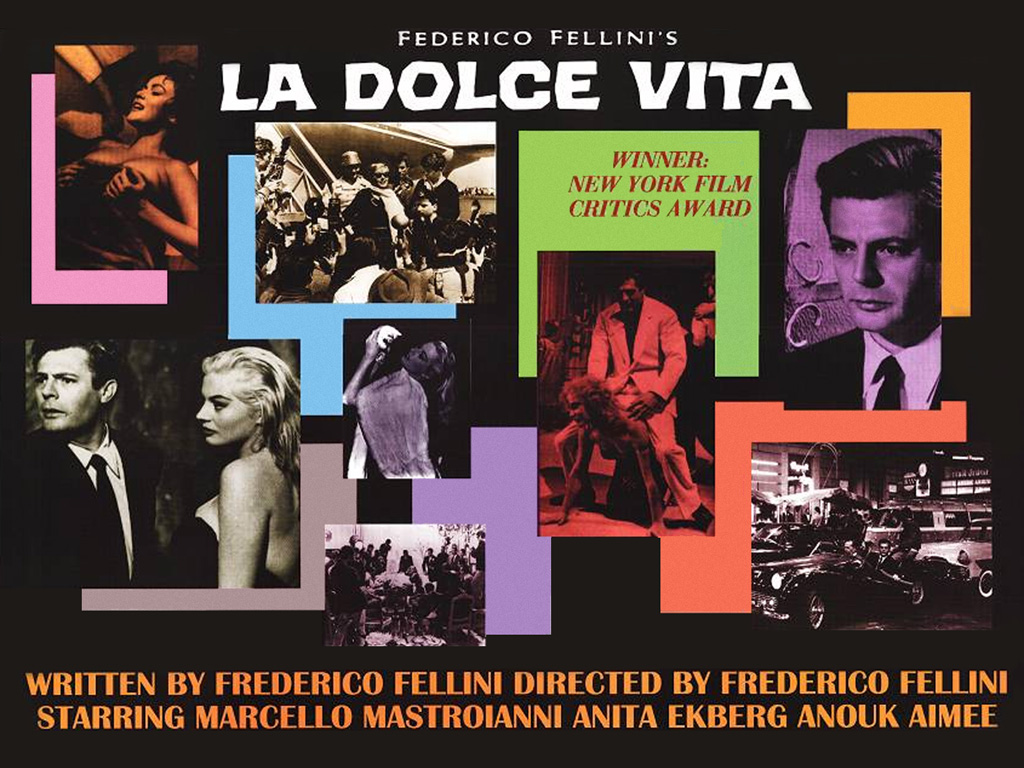
Federico Fellini:"La Dolce Vita" (1960)

La Dolce Vita (1960)
In one of the most widely seen and acclaimed European movies of the 1960s, Federico Fellini featured Marcello Mastrioanni as gossip columnist Marcello Rubini. Having left his dreary provincial existence behind, Marcello wanders through an ultra-modern, ultra-sophisticated, ultra-decadent Rome. He yearns to write seriously, but his inconsequential newspaper pieces bring in more money, and he's too lazy to argue with this setup. He attaches himself to a bored socialite (Anouk Aimée), whose search for thrills brings them in contact with a bisexual prostitute. The next day, Marcello juggles a personal tragedy (the attempted suicide of his mistress (Yvonne Furneaux)) with the demands of his profession (an interview with none-too-deep film star Anita Ekberg). Throughout his adventures, Marcello's dreams, fantasies, and nightmares are mirrored by the hedonism around him. With a shrug, he concludes that, while his lifestyle is shallow and ultimately pointless, there's nothing he can do to change it and so he might as well enjoy it. Fellini's hallucinatory, circus-like depictions of modern life first earned the adjective "Felliniesque" in this celebrated movie, which also traded on the idea of Rome as a hotbed of sex and decadence. A huge worldwide success, La Dolce Vita won several awards, including a New York Film Critics CIrcle award for Best Foreign Film and the Palme d'Or at the Cannes Film Festival.

Monday

John Huston:"The Maltese Falcon" (1941)

 The Maltese Falcon
After two previous film versions of Dashiell Hammett's detective classic The Maltese Falcon, Warner Bros. finally got it right in 1941--or, rather, John Huston, a long-established screenwriter making his directorial debut, got it right, simply by adhering as closely as possible to the original. Taking over from a recalcitrant George Raft, Humphrey Bogart achieved true stardom as Sam Spade, a hard-boiled San Francisco private eye who can be as unscrupulous as the next guy but also adheres to his own personal code of honor. Into the offices of the Spade & Archer detective agency sweeps a Miss Wonderly (Mary Astor), who offers a large retainer to Sam and his partner Miles Archer (Jerome Cowan) if they'll protect her from someone named Floyd Thursby. The detectives believe neither Miss Wonderly nor her story, but they believe her money. Since Archer saw her first, he takes the case -- and later that evening he is shot to death, as is the mysterious Thursby. Miss Wonderly's real name turns out to be Brigid O'Shaughnessey, and, as the story continues, Sam is also introduced to the effeminate Joel Cairo (Peter Lorre) and the fat, erudite Kasper Gutman (Sydney Greenstreet, in his film debut). It turns out that Brigid, Cairo and Gutman are all international scoundrels, all involved in the search for a foot-high, jewel-encrusted statuette in the shape of a falcon. Though both Cairo and Gutman offer Spade small fortunes to find the "black bird," they are obviously willing to commit mayhem and murder towards that goal: Gutman, for example, drugs Spade and allows his "gunsel" Wilmer (Elisha Cook Jr.) to kick and beat the unconscious detective. This classic film noir detective yarn gets better with each viewing, which is more than can be said for the first two Maltese Falcons and the ill-advised 1975 "sequel" The Black Bird.

Wednesday

Malik Bendjelloul:"Searching for Sugar Man" (2011)

Searching for Sugar Man
Two South African music lovers embark on a mission to uncover the fate of an obscure, 1970s-era U.S. rocker whose debut album became a surprise hit in their home country, and uncover a shocking secret along the way. Sixto Diaz Rodriguez had the kind of musical career that every aspiring rock star fears -- lauded by critics but ignored by the public, he released two albums before unceremoniously disappearing from the spotlight. But while sales of Rodriguez's debut CD Cold Fact fell flat in the U.S., overseas in Australia and South Africa, the fans couldn't get enough. In apartheid-torn South Africa in particular, Cold Fact became something of an anti-establishment classic, eventually going platinum. Later, rumors began to swirl that Rodriguez had suffered a horrible death. When Rodriguez's second album Coming From Reality makes it's belated debut in South Africa, a pair of devoted fans take it upon themselves to uncover the facts surrounding the mysterious musician, and get the surprise of a lifetime while attempting to track the profits from his record sales.

Tuesday

Jonas Ă…kerlund:"Spun" (2002)

Spun (2002)
A crystal-meth addict struggles to get his next fix as he obsesses over a recent breakup in Spun, a black-comic drug drama from music video director Jonas Akerlund. Rushmore's Jason Schwartzman stars as Ross, a young man who finds his maniacal world crumbling around him over the course of one long weekend. Spun chronicles Ross' travails as he tries to score from his regular dealer, Spider Mike (John Leguizamo), who realizes during Ross' visit that he's misplaced his stash. Indisposed by the frantic drug search, Spider Mike's girlfriend, Cookie (Mena Suvari), enlists Ross to pick up her stripper friend Nikki (Brittany Murphy) from work, and when he grudgingly agrees, he learns that Nikki might have an inside line on some of her own speed, courtesy of The Cook (Mickey Rourke). Meanwhile, two bumbling cops are onto Spider Mike's trail, and in his paranoid-delusional state, he sets out to find out who set him up. Spun premiered at the 2002 CineVegas Film Festival before securing berths at the Sundance, Toronto, and South by Southwest festivals.

Sunday

Gordon Parks:"Shaft" (1971)

Shaft (1971)
Richard Roundtree cuts a startlingly new and powerful heroic figure as John Shaft, "the cat who won't cop out, when there's danger all about" in Gordon Parks' seminal action film, Shaft. John Shaft is a black private eye with a small office near Times Square. On his way there one day, he gets pumped for information by Lt. Victor Androzzi (Charles Cioffi), a friend of his on the police force, about something big going down in Harlem involving black crime kingpin Bumpy Jonas (Moses Gunn). Shaft can't help him and leaves, only to just miss being waylaid by two of Bumpy's strong-arm men at his office, one of whom ends up dead on the pavement eight floors or so below. Squeezed by the cops, who are holding a potential manslaughter arrest over his head, Shaft contacts Bumpy, who reveals that his teenage daughter, whom he's always kept away from his business, has been kidnapped. There's been no ransom demand and no clue as to who did it, and he wants Shaft to find the culprits, insisting that he start with a group of Harlem-based black militants led by Shaft's onetime friend Ben Buford (Christopher St. John). No sooner does he find Buford, holed up in a decaying part of Harlem, however, than his friend's comrades are mowed down by submachine gun fire, and Shaft and Buford barely escape. With Shaft angry and out for blood, everyone is forced to come clean -- Bumpy knows that it's the Mafia that kidnapped his daughter, as they want in on the Harlem drug trade that he controls; they're holding her somewhere else outside of Harlem, where his men are no good to him, which is why he wanted Shaft to hook up with Buford. Androzzi tells Shaft that a dozen Mob trigger men from out of town have been spotted in Greenwich Village. He doesn't know why they're there, but he does know that if fighting breaks out between Bumpy's men and the Mafia, it's going to look like a race war, and the whole city could erupt. Shaft doesn't like the way he's been manipulated, but he sees Androzzi's point -- he links the trigger men to the kidnapping and finds the girl, but loses her again, getting shot in the process. Even though he's wounded, Shaft heads for a final confrontation with the kidnappers, supported by Ben's friends in an armed assault on the building where they're holed up.

Saturday

David Fincher:"Fight Club" (1999)

Fight Club
In this darkly comic drama, Edward Norton stars as a depressed young man (named in the credits only as "Narrator") who has become a small cog in the world of big business. He doesn't like his work and gets no sense of reward from it, attempting instead to drown his sorrows by putting together the "perfect" apartment. He can't sleep and feels alienated from the world at large; he's become so desperate to relate to others that he's taken to visiting support groups for patients with terminal diseases so that he'll have people to talk to. One day on a business flight, he discovers Tyler Durden (Brad Pitt), a charming iconoclast who sells soap. Tyler doesn't put much stock in the materialistic world, and he believes that one can learn a great deal through pain, misfortune, and chaos. Tyler cheerfully challenges his new friend to a fight. Our Narrator finds that bare-knuckle brawling makes him feel more alive than he has in years, and soon the two become friends and roommates, meeting informally to fight once a week. As more men join in, the "fight club" becomes an underground sensation, even though it's a closely guarded secret among the participants. (First rule: Don't talk about fight club. Second rule: Don't talk about fight club.) But as our Narrator and Tyler bond through violence, a strange situation becomes more complicated when Tyler becomes involved with Marla (Helena Bonham Carter), whom our Narrator became infatuated with when they were both crashing the support-group circuit. Based on the novel by Chuck Palahniuk, Fight Club was directed by David Fincher, who previously directed Pitt in the thriller Seven.

Tuesday

Alfred Hitchcock:"North by Northwest" (1959)

North by Northwest (1959)
While having lunch at the Plaza Hotel, advertising executive Roger O. Thornhill (Cary Grant) has the bad luck to stand up just as a "George Kaplan" is being paged. From this point on, Thornhill's life is turned upside down. He is abducted by three mysterious men and whisked away to the palatial home of enemy spy Phillip Vandamm (James Mason). Denying that his name is Kaplan, Thornhill is at a complete loss when Vandamm begins grilling him for information. Finally, Thornhill is forcibly intoxicated, tossed into a car, and sent careening down a treacherous mountain road. He escapes this death trap only by attracting the attention of a couple of cops in a squad car, but must bring the car to a sudden halt, and is promptly rear-ended by the car and arrested for drunk driving. Unable to persuade the law that his stories of kidnappings and enemy agents is true -- he can't even convince his own mother (Jesse Royce Landis) -- Thornhill takes the cops back to the mansion where he was held prisoner, only to find that Vandamm and company have cleared out, and that the house is really owned by United Nations ambassador Lester Townsend (Philip Ober). Tracking down Townsend at the UN building, Thornhill tries to get the man's attention -- whereupon Townsend is knifed to death, and the nonplussed Thornhill left holding the weapon. Now a fugitive from justice, Thornhill tries to escape via train. En route, he meets the cooly beautiful Eve Kendall (Eva Marie Saint), who graciously hides him from the police. The apotheosis of Alfred Hitchcock's Hollywood career, North by Northwest is fast, funny, and exciting. The film contains far too many highlights to detail in this limited space; standout bits include the crop-duster dusting where there aren't any crops, the riotous auction scene, and, of course, that nail-biting Mount Rushmore finale.

Friday

Quentin Tarantino:"Django Unchained" (2012)

Django Unchained (2012)
A former slave and a German bounty hunter become unlikely allies in the battle against a tyrannical plantation owner in this western from visionary director Quentin Tarantino. Two years before the Civil War pits brother-against-brother, German-born fugitive hunter Dr. King Schultz (Academy Award-winner Christoph Waltz) arrives in America determined to capture the outlaw Brittle brothers dead or alive. In the midst of his search, Dr. Schultz crosses paths with Django (Academy Award-winner Jamie Foxx), a freed slave and skilled tracker who seeks to rescue his beloved wife Broomhilda (Kerry Washington) from ruthless plantation owner Calvin Candie (Academy Award-nominee Leonardo DiCaprio). Once Django has aided Dr. Schultz in coralling the Brittle brothers, the two team up to capture some of the most wanted men in the South. Meanwhile, Django never loses sight of his mission to free Broomhilda from the treacherous slave trade before it's too late. Upon arriving at Candie's nefarious plantation, dubbed Candyland, Django and Dr. Schultz discover that slaves are being groomed for gladiator-like competitions by Candie's malevolent right-hand man Billy Crash (Walton Goggins), and together they skillfully work their way onto the compound for a closer look. But just as Django and his partner locate Broomhilda and plot a daring escape, Candie's house slave Stephen (Academy Award-nominee Samuel L. Jackson) catches wind of their plan, and informs his master of the betrayal. Now, as a clandestine organization attempts to back them into a corner, Django and Dr. Schultz will have to come out with pistols blazing if they ever hope to free Broomhilda from Candyland and the clutches of its vile proprietor.

Tuesday

Rob Reiner:"Misery" (1990)

Misery
Adapted from a Stephen King novel, Rob Reiner's Misery cast James Caan as a writer at a career crossroads. The film opens with Paul Sheldon (Caan) completing work on his latest novel, a break from his popular series of novels featuring the character Misery Chastain. He gets into a severe car accident and is saved by Annie Wilkes (Kathy Bates), a reclusive woman who nurses him back to health. Annie is a huge fan of the Misery novels, and she finishes reading the new one while Paul is convalescing. She becomes enraged when she discovers that Paul has killed off Misery. Annie injures Paul's foot severely so that he is unable to leave her house, and forces him to write a new Misery novel. A local sheriff (Richard Farnsworth) and Paul's agent (Lauren Bacall) both attempt to track down what happened to the missing author. Misery shot the relatively unknown Kathy Bates to stardom, winning her one of the few Best Actress Oscars ever bestowed for portraying an evil character.

Saturday

Ridley Scott:"Blade Runner" (1982)

Blade Runner (1982)
A blend of science fiction and noir detective fiction, Blade Runner (1982) was a box office and critical bust upon its initial exhibition, but its unique postmodern production design became hugely influential within the sci-fi genre, and the film gained a significant cult following that increased its stature. Harrison Ford stars as Rick Deckard, a retired cop in Los Angeles circa 2019. L.A. has become a pan-cultural dystopia of corporate advertising, pollution and flying automobiles, as well as replicants, human-like androids with short life spans built by the Tyrell Corporation for use in dangerous off-world colonization. Deckard's former job in the police department was as a talented blade runner, a euphemism for detectives that hunt down and assassinate rogue replicants. Called before his one-time superior (M. Emmett Walsh), Deckard is forced back into active duty. A quartet of replicants led by Roy Batty (Rutger Hauer) has escaped and headed to Earth, killing several humans in the process. After meeting with the eccentric Eldon Tyrell (Joe Turkel), creator of the replicants, Deckard finds and eliminates Zhora (Joanna Cassidy), one of his targets. Attacked by another replicant, Leon (Brion James), Deckard is about to be killed when he's saved by Rachael (Sean Young), Tyrell's assistant and a replicant who's unaware of her true nature. In the meantime, Batty and his replicant pleasure model lover, Pris (Darryl Hannah) use a dying inventor, J.F. Sebastian (William Sanderson) to get close to Tyrell and murder him. Deckard tracks the pair to Sebastian's, where a bloody and violent final confrontation between Deckard and Batty takes place on a skyscraper rooftop high above the city. In 1992, Ridley Scott released a popular director's cut that removed Deckard's narration, added a dream sequence, and excised a happy ending imposed by the results of test screenings; these legendary behind-the-scenes battles were chronicled in a 1996 tome, Future Noir: The Making of Blade Runner by Paul M. Sammon.

Friday

Rian Johnson:"Looper" (2012)

A hired gun from the future discovers that his greatest adversary is himself in this twisting sci-fi mindbender starring Bruce Willis and Joseph Gordon-Levitt, and directed by Rian Johnson (Brick, The Brothers Bloom). In the year 2047 time travel has yet to be invented. Thirty years later, however, it has. Though immediately outlawed, time-travel technology is quickly appropriated by the mob, and used to cleanly dispose of anyone deemed a threat. The process is simple: When the mob wants someone to disappear, they simply send them back to the year 2047, where an assassin known as a "looper" quickly carries out the hit, and disposes of the body. Joe Simmons (Gordon-Levitt) is one of the most respected loopers around. Each kill earns him a big payday, and he's got big plans to retire to France. Then, one day, as Joe patiently awaits the appearance of his next target near the edge of a remote corn field, he's shocked to come face-to-face with his future self (Bruce Willis). When the younger Joe hesitates, the older Joe makes a daring escape. Now, in order to avoid the wrath of his underworld boss (Jeff Daniels), young Joe must "close the loop" and kill his older counterpart. Meanwhile, the revelation that a powerful crime boss in the future has set the underworld ablaze pits the two Joes on a violent collision course, with the fate of a devoted mother (Emily Blunt) and her young son hanging in the balance. Paul Dano and Piper Perabo co-star.

Wednesday

Todd Solondz:"Welcome to the Dollhouse" (1995)

Welcome to the Dollhouse
Twelve-year-old Dawn Wiener (Heather Matarazzo) is perhaps the most put-upon adolescent in film history in Todd Solondz's bitterly hilarious black comedy Welcome To The Dollhouse. Dawn is bright but awkward, both physically and socially, and is appallingly unpopular among her peers, to whom she's better known as "Wienerdog." Possessing little charm or grace and perhaps the most misguided fashion sense of her generation, Dawn is not an easy girl to like and practically no one seems interested in making the effort. If life is tough for Dawn at school, it's hardly any better at home. While her folks dote on her gratingly cute younger sister Missy (Daria Kalinina) and look with pride to her bookish older brother Mark (Matthew Faber), Dawn is either ignored or treated as an annoyance. Dawn has developed a crush on Steve (Eric Mabius), the hunky guitarist Mark has drafted into his rock band (significantly, Mark is less interested in making cool noise or unloading teenage angst than in having another extracurricular activity to put on his college applications); Steve is polite but obviously not interested in her. However, Dawn has attracted the attention of a boy at school -- Brandon (Brendan Sexton), a mean-spirited junior thug whose idea of a good time is threatening Dawn with rape. A painfully accurate account of life in junior high (what Matt Groening called "the lowest pit of hell"), Welcome To The Dollhouse is also very funny, but writer and director Todd Solondz never lets the film's humor dilute the agony of its leading character; anyone who has ever been 12 years old will doubtless laugh at Dawn while uncomfortably recalling the horror of their own preteen years.

Sunday

Arthur Penn:"Night Moves" (1975)

Night Moves (1975)
Like Robert Altman's The Long Goodbye (1973) and Roman Polanski's Chinatown (1974), Arthur Penn's Night Moves rethinks the conventions of 1940s film noir with a 1970s sensibility. In the noir world, the L.A. lifestyles of the rich and famous masked an amoral core over which the detective could momentarily assert his ethical power; in Penn's 1970s version (as in those of Altman and Polanski), the detective cannot even manage that small a victory. The noir shadows that swathe Harry Moseby's Florida trip in Night Moves only emphasize how little he can see of what is really happening; and even what action Harry (Gene Hackman) can see is blocked by clear water and glass barriers. Increasingly less receptive to films that delved into the unethical morass of contemporary America, the audience did not embrace Night Moves as earlier ones had Penn's previous revisionist genre movies, Bonnie and Clyde (1967) and Little Big Man (1970). Still, the final image of this Penn outing indelibly sums up the quandary of a detective with some grasp of how to do the right thing, faced with a society that couldn't care less.

Tuesday

Jerry Schatzberg:"Scarecrow" (1973)

Scarecrow (1973)
An ex-con learns the value of friendship in Jerry Schatzberg's picaresque road movie. Trying to hitch a ride on a desolate California road, fresh-out-of-prison Max (Gene Hackman) meets ex-sailor Lion (Al Pacino). They are both headed east, as Max dreams of opening a deluxe car wash in Pittsburgh and Lion believes that the wife and child he left behind will still welcome him home. The two decide to journey together, forging an increasingly deep yet uncertain friendship, as Lion teaches Max how not to be so pugnacious and Max senses Lion's fragility. When the pair hits Detroit, Lion finally gets in touch with his wife and discovers how she really feels. When Lion is shattered by the revelation, Max must decide if he should forge on alone or sacrifice his carefully guarded savings to help his friend. One of a cycle of late 1960s-early 1970s buddy movies that included Midnight Cowboy (1969) and California Split (1974), Scarecrow suggests how alienated men had become from such traditional institutions as marriage and family. Max's and Lion's salvation comes from being on the road with each other, rather than settling down with jobs and families. Pacino's first film after his triumph in The Godfather (1972), and Hackman's follow-up to The Poseidon Adventure (1972) and his Oscar for The French Connection (1971), Scarecrow won the 1973 Palme d'Or at the Cannes Film Festival, but the two stars were not enough to make it a hit. Even so, their nuanced performances enhance this moody study of contemporary dislocation.

Monday

David Fincher:"The Girl With the Dragon Tattoo" (2011)

The Girl With the Dragon Tattoo (2011)
A literary phenomenon that has swept the globe, Stieg Larsson's The Girl With the Dragon Tattoo arrives on the big screen courtesy of director David Fincher and Academy Award-winning screenwriter Steven Zaillian. The result is a sturdily scripted, assuredly directed thriller that gradually lures us into a labyrinthine mystery involving a discredited journalist, a cryptic computer hacker, and a wealthy family harboring some particularly dark secrets. Notably absent outside of the visually striking (yet somewhat inexplicable) black-drenched credit sequence set to Trent Reznor and Karen O's pulsing version of Led Zeppelin's "Immigrant Song," however, is the dynamic and innovative visual style that has defined much of Fincher's finest work.
Journalist Mikael Blomkvist (Daniel Craig) has just lost a highly publicized court battle against powerful entrepreneur Wennerström (Ulf Friberg) when he is summoned to the remote island estate of aging businessman Henrik Vanger (Christopher Plummer), who makes him a most-unusual proposition. Forty years ago, Henrik's beloved great-niece Harriet vanished without a trace. Henrik is convinced that someone in his family -- where greed and Nazism run rampant -- has gotten away with murder, and despite the firestorm of controversy over Blomkvist's credibility, he's certain that the seasoned reporter can root out the killer. Meanwhile, as Blomkvist submerses himself in a mystery decades in the making, misfit computer hacker Lisbeth Salander (Rooney Mara) finds her violent past returning with a vengeance thanks to her twisted new parole officer (Yorick van Wageningen). Before long, Blomkvist and Salander are working together as a team to investigate the Vanger family, who all live on the same island yet display an indifference to one another that often spills over into outright animosity. But with each new clue that Blomkvist and Salander uncover, the more apparent it becomes that Harriet's disappearance may in fact lead them directly into an even darker mystery.
In Seven and Zodiac, Fincher used masterful pacing, atmospheric cinematography, and acute attention to detail to seduce us into grim worlds of murder and obsession. Those familiar themes are still very much propelling factors in The Girl With the Dragon Tattoo, though this time Fincher comes off as much more restrained than usual. It's unclear whether that's a result of his not being as emotionally invested in the material or simply recognizing the need to get out of the way of a good story, but by reteaming with cinematographer Jeff Cronenweth (Fight Club, The Social Network), Fincher still gives The Girl With the Dragon Tattoo an exquisitely chilly visual scheme that provides a palpable sense of atmosphere while holding the audience at arm's length. It's a good match for a such a pulpy mystery, though a little of the director's trademark inventiveness could have gone a long way in not only distinguishing Fincher's take on the story from the previously filmed Swedish-language version, but also in helping to connect the dots of The Girl With the Dragon Tattoo's somewhat contrived storyline.
An astonishing blend of dark allure and damaged brilliance, Mara is compulsively watchable as Lisbeth Salander, while Craig effectively embodies quiet integrity as the humiliated reporter fleeing the limelight while sharpening his investigatory skills. Compelling as both characters are, however, Fincher's cool direction stunts any attempts to form an emotional connection with them, even when Mikael and his daughter have a gentle conversation about faith, or the scene in which Lisbeth bares her soul to her investigative partner by confessing how she got caught up in the legal system in the first place. And while a scene of shocking violence between Lisbeth and her sadistic parole officer may be off-putting to some, its contextual relevance is all but undeniable once we've learned her darkest secret.

Given the lurid nature of Stieg Larsson's story, it's easy to see why Fincher would be compelled to adapt it for the big screen. But it's impossible not to feel like we've been down this road numerous times with the director before. In The Social Network, it felt as if Fincher were truly growing as a filmmaker both thematically and stylistically. Despite being a solid mystery assuredly told, The Girl With the Dragon Tattoo feels like something of a regression -- one that's largely absent of the factors that established him as one of his generation's most innovative filmmakers.

Friday

John Schlesinger:"Midnight Cowboy" (1969)

Midnight Cowboy (1969)
After earning notoriety as one of the first major studio films to be given an X rating (it was later re-rated R), Midnight Cowboy made history as the first X-rated film to win an Oscar for Best Picture. A brutal depiction of broken dreams and lives asunder in the fetid backwash of the swinging Sixties, Cowboy shocked audiences with its squalid subject matter and signaled a trend towards films that explored lurid and personal material. Whereas the mere suggestion of a blow job in Cowboy was scandalous in 1969, the film helped pave the way for later mainstream films in which a blow job might have as much shock value as the weather forecast. For that reason, Cowboy loses a substantial part of its impact when viewed all these years after its original release. That said, as a buddy film and as an ode to the impossibility of liberation from reality, the film retains a certain timelessness. Jon Voight's handsome but stupid Joe Buck and Dustin Hoffman's desperate, verminous Ratso Rizzo remain iconic figures, symbolic of the resigned, bitter ending of a decade built on the tenets of liberation, progressive change, and the promise of collective struggle. The fate of Buck and Rizzo suggests that such liberation is illusory, and that human relations, no matter how tender they ultimately may be, are part of a quiet, desperate bid for acceptance and belonging.

Saturday

Samuel Fuller:"The Naked Kiss" (1964)

The Naked Kiss (1964)
Kelly (Constance Towers), a prostitute who wants to transform her life, beats up her pimp, takes the 75 dollars he owes her, and leaves town. Winding up in the small town of Grantville, she turns a trick with Griff (Anthony Eisley), who is actually the sheriff. After paying her for sex, Griff tells Kelly that Grantville is a clean town and orders her out, though he refers her to a brothel in a neighboring city. Instead, Kelly makes a final break with her past and becomes a nurse's aide at the local children's hospital. In that capacity, she meets Grant (Michael Dante), who is a benefactor of the hospital, a descendant of the town's founder -- and Griff's best friend. As Grant and Kelly fall in love, Griff viciously accuses Kelly of using her hospital job to hide ongoing illicit activities. When Kelly tells Grant about her past, he seems to accept her without reservation and proposes marriage; however, Kelly soon learns the perverse truth about her fiancée and takes matters into her own hands. Samuel Fuller's raw film noir exposes the hypocrisy of a supposedly proper society. Beneath the veneer of respectability lies an exploitive abuse of power, no different from that of any pimp.

Monday

David Cronenberg:"Videodrome" (1982)

Indierider:Videodrome
Well before he adapted William S. Burroughs' Naked Lunch, David Cronenberg's debt to the beat writer was laid bare with Videodrome, a phantasmagoric journey through fractured psyches and cathode tubes. The film features several of Burroughs's trademarks, including a stream-of-consciousness narrative, a paranoid, conspiratorial tone, and overriding themes of desire and addiction. At the same time, this movie is perhaps the best articulated vision of Cronenberg's ongoing exploration of the edges of technology and human physiology. Detailing the transformation of a sleazy television producer into literal media terrorist, Cronenberg presents a world of pulsating videotapes, televisions that undulate like flesh, and large, vagina-like abdomen slashes that function as a biomechanic VCR. Though the technology, special-effects, and fashion sensibilities all seem dated, Cronenberg's basic questioning of the media through Max Renn's particular psychological affliction seems more relevant today than it did when his film was first released. As technology becomes more advanced, Cronenberg explores not only whether it will affect our sense of reality but also our evolution as a species. His Videodrome is a postmodern masterpiece that unsettles, shocks, and provokes.

Twitter Delicious Facebook Digg Stumbleupon Favorites More